
Why Legacy CRMs are Stalling Mid-Market Retail Growth
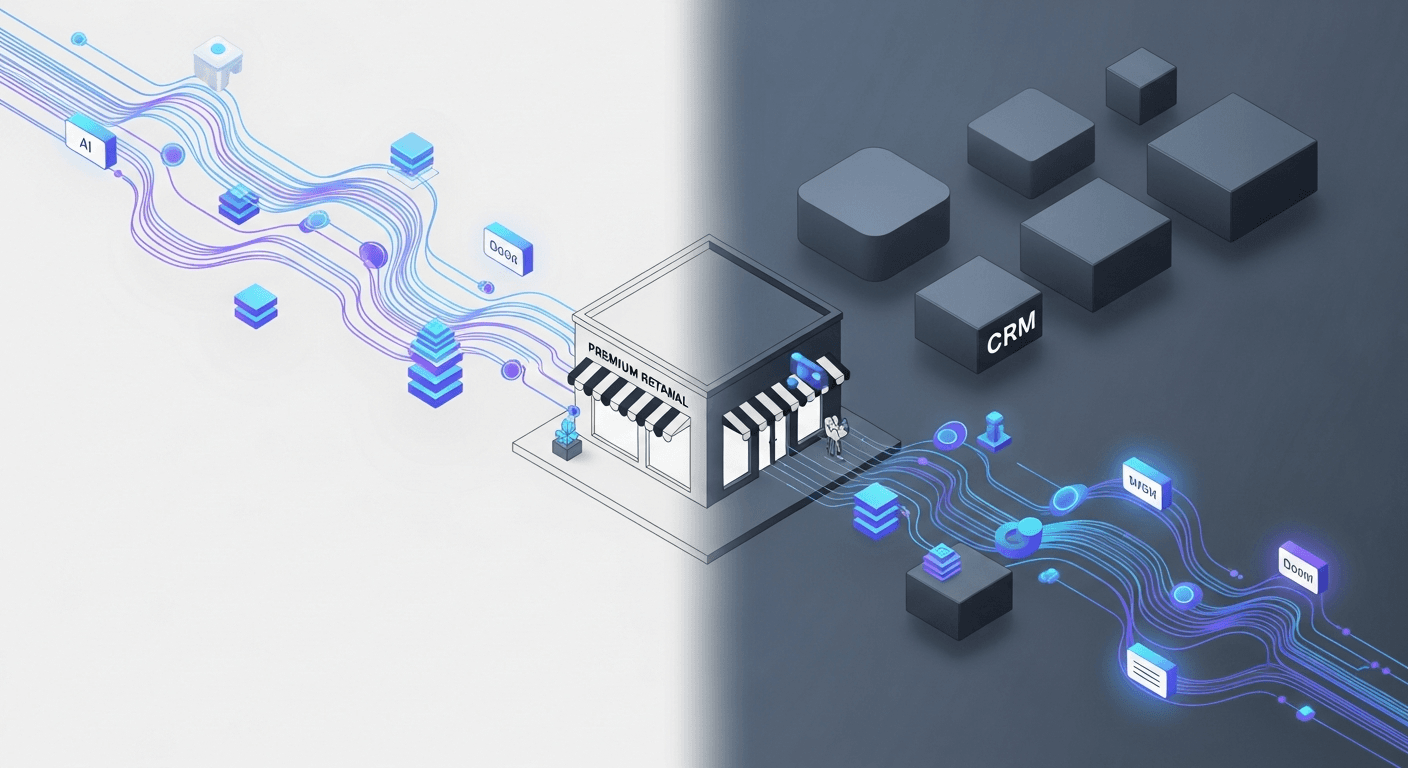
Legacy CRMs are the Silent Growth Killers of Mid-Market Retail
For retailers in the $50M to $1B revenue bracket, the tech stack has moved out of the server room and onto the balance sheet. It is no longer a backend utility; it is the primary engine of top-line growth. Yet, a staggering number of mid-market firms remain tethered to legacy Customer Relationship Management (CRM) systems built for a version of commerce that no longer exists.
These systems have evolved from minor operational headaches into active inhibitors of scale. On October 10, 2023, Gartner reported that 70% of mid-market retailers using legacy CRMs cited stalled growth directly linked to integration failures and stagnant functionality. As retail moves toward an omnichannel, AI-driven reality, the gap between what these old systems can do and what the market demands is becoming a chasm.
The High Cost of the Status Quo
Maintaining a legacy system isn't just a conservative choice; it’s an expensive one. Gartner’s research indicates that mid-market retailers on legacy platforms face operational costs 25% higher than their digitally agile competitors. These aren't always line-item expenses. They are "hidden" costs buried in manual data entry, the endless maintenance of custom middleware, and the labor-intensive struggle to reconcile disconnected data sets.
Speed is the only currency that matters in modern retail. Organizations hampered by outdated interfaces and a lack of real-time analytics see decision-making speeds drop by 18%. When your insights are delayed by 48 hours, you’ve already missed the window to pivot on inventory imbalances or shifting consumer trends. Vala Afshar, Chief Digital Evangelist at Salesforce, hit the nail on the head this past October: using these systems is like carrying a "flip phone in a smartphone world." Mid-market retail cannot survive the latency inherent in pre-real-time architecture.
Data Fragmentation is a Revenue Leak
Legacy CRMs are the primary architects of data silos. According to an October 2023 Forrester report, 65% of mid-market retailers suffer from significant data fragmentation. Because these older systems lack the robust API frameworks required for modern integration, customer intelligence stays trapped. Online purchase histories don't talk to in-store loyalty data; email engagement metrics don't reflect recent returns.
This isn't just an organizational annoyance—it’s a drain on the bottom line. RIS News data shows that 40% of mid-market retailers still on legacy systems report a 10% revenue loss specifically due to poor inventory-CRM synchronization. If your system cannot provide a unified view of the customer and the product simultaneously, you are essentially guessing. The result is overstocking, missed sales, and a disjointed customer experience that drives buyers elsewhere.
The Retention Crisis
Customer retention drives mid-market profitability, but legacy systems are failing to protect it. A Forrester study from October 12, 2023, found that legacy CRM users in the retail sector saw customer retention rates drop by 15% last year.
Today’s consumer expects a seamless transition between digital and physical touchpoints. Legacy CRMs, which struggle to process real-time segment updates or multi-channel automation, cannot provide the personalized engagement required to build loyalty. Without a 360° view of the customer—lifecycle stage, channel behavior, and purchase history—your marketing efforts are just noise.
Moving from Reactive to Predictive
AI integration is no longer a "future" trend; it is a strategic necessity for survival. AI-enhanced CRMs are currently driving a 20-30% boost in personalized marketing effectiveness. This isn't about "bot" chats; it’s about moving from reactive outreach to predictive engagement.
HubSpot’s 2023 survey found that AI-powered CRMs increase retail upsell opportunities by 22%. By using machine learning to analyze historical patterns, retailers can forecast demand and identify churn risks before the customer actually leaves. Legacy systems lack the computational architecture to run these models. While your competitors are calculating their next move, you’re still trying to export a CSV.
The Security Myth
Proponents of on-premise legacy systems often point to security as a reason to stay put. They aren't entirely wrong—a 2023 Deloitte study noted that 55% of breaches hit cloud-based CRMs. However, this view is dangerously narrow.
The real operational risk isn't just a breach; it’s a total system failure. Social media is currently littered with "CRM horror stories" of outdated systems causing catastrophic crashes during Black Friday peaks. Modern cloud solutions offer enterprise-grade security and encryption patches that legacy systems simply cannot match. The greatest risk to your business isn't the cloud—it’s an inability to adapt to a market that demands both security and agility.
A Pragmatic Path to Migration
Swapping software won't fix a broken process. For mid-market retailers, the transition from a legacy environment to a modern intelligence layer must be tied to measurable KPIs. At Skewes AI, we approach this through a lens of data readiness and operational reality.
- Strategy and Consulting: Before touching the tech, we assess your current innovation capacity. We build a roadmap that aligns with your boardroom goals, ensuring the migration is a business transformation, not just an IT project.
- Data Intelligence: To kill the silos, you need robust data pipelines. We focus on transforming fragmented, raw data into an intelligence layer that finally provides that elusive 360° customer view.
- Specialized Retail Tooling: Generalist CRMs often fail in a retail context. We utilize solutions like RetAI CRM, which features built-in RFM (Recency, Frequency, Monetary) engines and automated multi-channel tools to identify high-value or at-risk customers in real-time.
- Predictive Analytics: Once your data is unified, we apply machine learning models to forecast trends and predict demand. This moves your team away from generic promotions and toward targeted strategies that drive ROI.
The data is clear: legacy CRMs have become a ceiling on your growth. With 70% of your peers reporting stalled progress due to integration issues, the time for incremental updates is over. To compete in a market defined by real-time data, you need an agile system that prioritizes intelligence over storage.
Unlock Your Data Intelligence. Schedule a Consultation with Skewes AI today to assess your data readiness and build a roadmap for measurable retail growth. #PracticalAI #EnterpriseGrowth #DataIntelligence #MidMarketTech